
Eva Tocino: closing nutrient cycles on a small livestock farm
Setting up a crop or livestock farm from scratch is no easy task. Eva Tocino lives in San Muñoz, in the Campo Charro (Salamanca, Spain), a region with a strong livestock farming tradition; however, her family were not involved in this sector and did not own any land in the area. Eva hadn’t even studied agronomy – she’d studied technical architecture – but she’d long been thinking about living in the village and running a beef cattle farm where the animals would feed on the existing pastures as well as locally produced fodder. And she set to work. Little by little, drawing on his savings and taking out smallloans, he began to buy or lease small plots of land, as if piecing together a jigsaw puzzle. And his idea became a reality.
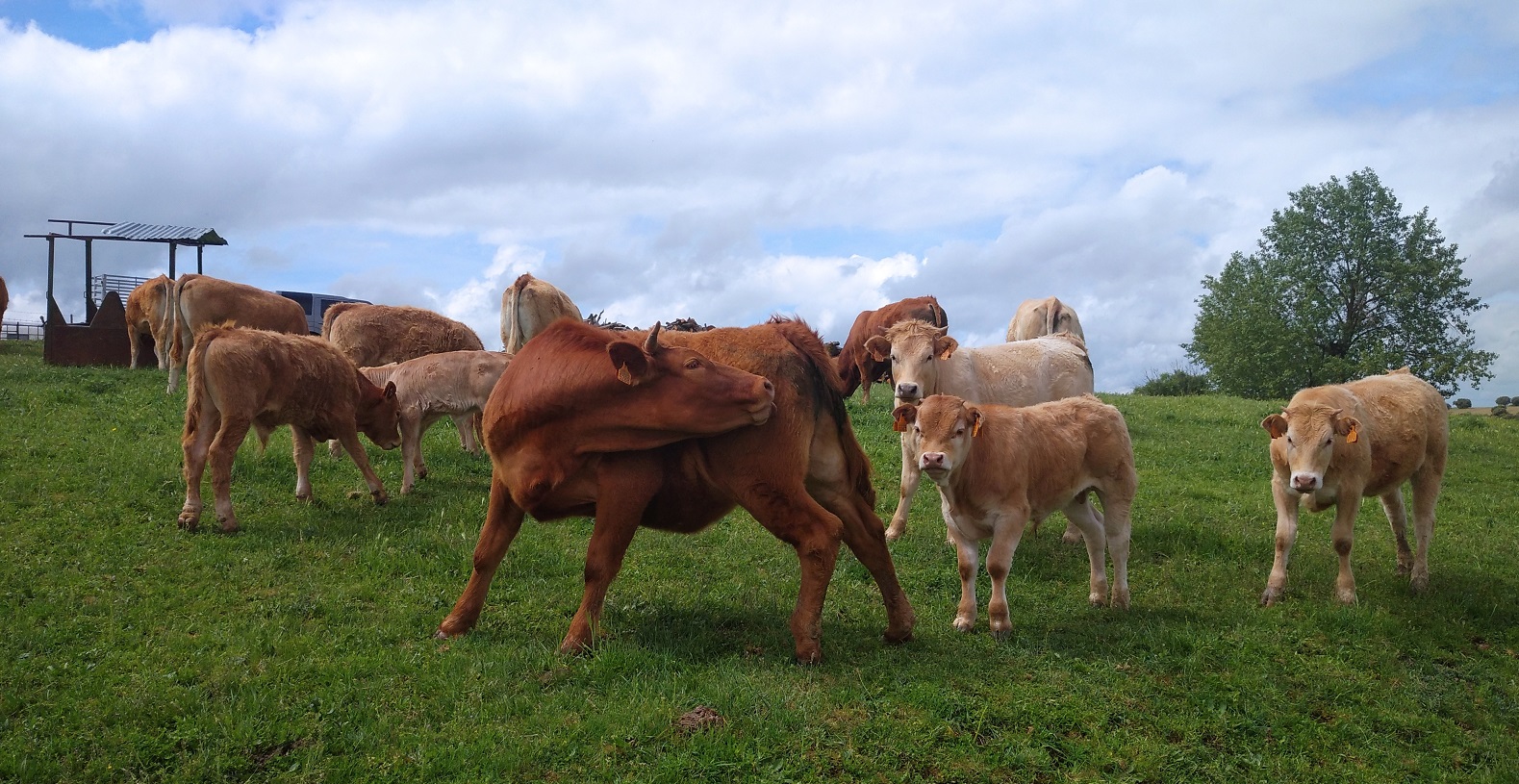
Eva currently manages a total of 136 hectares, divided into small plots. Just over half of this (around 80 hectares) consists of pastureland, whilst on the remainder (55 hectares) she grows ryegrass,cereals such as oats and rye, and Leguminous plants such as chickpeas and vetch, to feed a diverse herd of around 50 cows of mixed ages and breeds. Herfarm is one in which arable farming and livestock farming are fully integrated,closing the nutrient cycles, and assuring her certain independence from external inputs.
Thus, Eva does not merely grow feed for her livestock; every year, after the harvest, she also lets the flock graze on the cropland to make use of the crop residues, and uses the manure produced by the animals to fertilise the soil. Following the principles of regenerative agriculture, she has reduced tillage, carrying out just 1–2 passes with a chisel plough per year. In 2026, she carried out just one pass before sowing, in fact. She also tends to leave small areas to grow grains to feed birds, which had enabled her to adhere to CAP eco-scheme on biodiversity, on certain years.
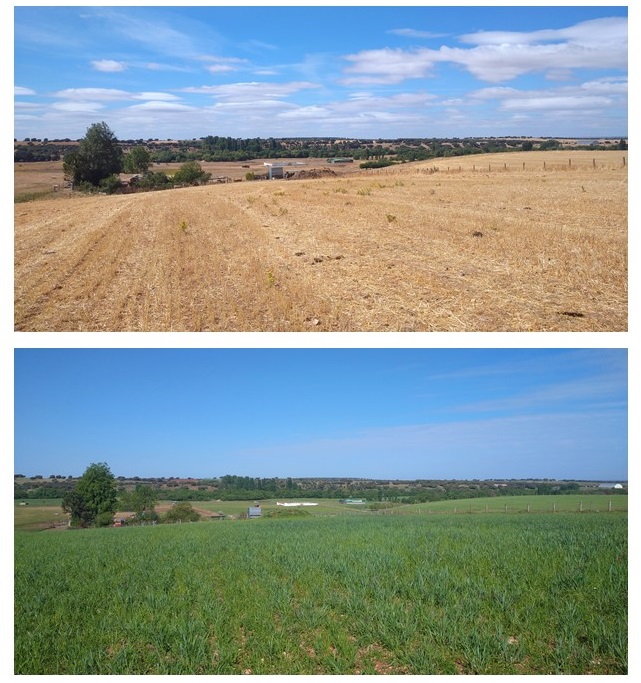
Eva recognises the value of her farm as a pilot scheme for the development of innovative agricultural practices, and has collaborated on several research projects, such as ECOPIONET and, more recently, LILAS4SOILS, which she joined in 2025 after being selected through the open call launched by IBERSOILL. Over the coming years, she intends to use the momentum provided by the project and her involvement with the Living Lab to analyse which combination of practices is most effective for improving soil health. Specifically, on one of its plots, following a design developed in collaboration with the Agricultural Technology Institute of Castile and León (ITACyL, according to the acronym in Spanish), she is trialling a new crop rotation in which it has incorporated a semi-permanent green cover capable of re-growing after the summer, whilst carrying out the usual tasks (incorporating manure and feeding the livestock) in adjacent areas.
Eva’s farm faces a number of challenges, amongst others, and like many other small-scale farms involved in professional agriculture; low selling prices for produce, a shortage of processing industries, the high cost of inputs, and difficulties in acquiring or gaining access to suitable machinery. But her drive, their resilience and their collaboration with other small-scale producers in similar situations will undoubtedly help them to tackle these challenges successfully.

Funded by the European Union (Grant no. 101157414). Views and opinions expressed are however those of the author(s) only and do not necessarily reflect those of the European Union, European Research Executive Agency (REA). Neither the European Union nor any other granting authority can be held responsible for them.

