Lorem ipsum dolor sit amet, consectetur adipiscing elit, sed do eiusmod tempor incididunt ut labore et dolore magna aliqua. Ut enim ad minim veniam

Fostering Carbon Farming Practices through Living Labs in the Mediterranean & Southern EU for the healthy future of European soils
Restoring Soils, Growing Futures
Our dedication to advancing soil health ensures a sustainable future.
Andrea Fiorini – Università Cattolica del Sacro Cuore
Valeria Forlin – European Commission (DG CLIMA)
Andrea Ferrarini – Università Cattolica del Sacro Cuore
Nicolaj Franceschi – Università Cattolica del Sacro Cuore
Objectives of the conference, meaning of Carbon Farming and CC, and LILAS4SOILS overview – Vincenzo Tabaglio & Sonia Pietosi
Monitoring and quantification of removals of C – Marco Acutis
SHARE: the living lab for C farming – Andrea Fiorini
SHARE Living lab launch event LILAS4SOILS - Leonhard Maier
Carbon Removals and Carbon Farming certification framework- Valeria Forlin
Guzzetti, L., Fiorini, A., Panzeri, D., Tommasi, N., Grassi, F., Taskin, E., Misci, C., Puglisi, E., Tabaglio, V., Galimberti, A., Labra, M., 2020. Plants, 9(1), 48.
Fiorini, A., Boselli, R., Amaducci, S., Tabaglio, V., 2018. European Journal of Agronomy, 99, 156-166.
Lorem ipsum dolor sit amet, consectetur adipiscing elit, sed do eiusmod tempor incididunt ut labore et dolore magna aliqua. Ut enim ad minim veniam Lorem ipsum dolor sit amet, consectetur adipiscing elit, sed do eiusmod tempor incididunt ut labore et dolore magna aliqua. Ut enim ad minim veniamLorem ipsum dolor sit amet, consectetur adipiscing elit, sed do eiusmod tempor incididunt ut labore et dolore magna aliqua. Ut enim ad minim veniamLorem ipsum dolor sit amet, consectetur adipiscing elit, sed do eiusmod tempor incididunt ut labore et dolore magna aliqua. Ut enim ad minim veniam Lorem ipsum dolor sit amet, consectetur adipiscing elit, sed do eiusmod tempor incididunt ut labore et dolore magna aliqua. Ut enim ad minim veniam
.jpg)

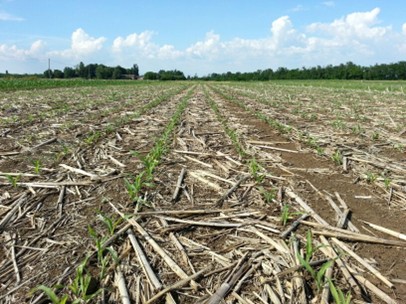
This site represents a long-term no-till arable system in the western Po Valley. Soil-health practices include no tillage, residue retention, cover crops between wheat and maize, and the planned strengthening of rotations through multi-species cover crops, together with improved nutrient management and organic matter inputs. Main crops are alfalfa (feed), wheat (mainly food, but potentially dual-use) and maize (mainly feed), with cover crops used as service crops.

This is an arable lowland site under minimum tillage (10–15 cm), with crop residues generally left in the field and sub-irrigation. Soil-health actions focus on better nutrient timing, wider use of cover crops, improved crop rotation design and continued reduced tillage. The main crops are peas (food) and maize (food).

This is a field experimental site with an already established rotation and cover crop component. Soil-health management is based on organic fertilisation, incorporation of residues, and the maintenance of a three-year rotation supported by cover crops. The crops under observation are maize (mainly feed but also food), sunflower (food/oilseed) and soybean (food/feed protein crop).

This is a mixed dairy farm where soil health is addressed through the use of solid and liquid manure, improved nutrient timing, planned use of nitrification inhibitors, introduction of cover crops and a shift from ploughing to minimum tillage. The cropping system includes wheat and winter forage mixtures (feed-oriented) and maize silage (feed).

This is the SHARE supersite and a field-experimental site with side-by-side conventional and no-till management. Soil-health practices include residue retention, cover crops in no-till sectors, diversified rotations with grasses and legumes, and reduced soil disturbance, alongside nutrient management tailored to crop needs. The key crops are maize (feed) and soybean (food/feed), within an experimental setting particularly suitable for intensive monitoring and demonstration.

This large arable farm represents an intensive Po Valley system transitioning from ploughing-based management towards minimum tillage, better nutrient timing, improved cover cropping and more diversified crop sequences. Crop residues are retained. The main crops are barley (food/feed), maize (food), sunflower (food/oilseed) and soybean (food/feed).

This is a forage-oriented mixed farm already managed under no tillage, with residues left on the field and both organic and chemical fertilisation. Soil-health work is based on maintaining reduced disturbance in both cropland and grassland conditions. The main crop under the current DS is alfalfa (feed), within a broader forage rotation linked to livestock farming.

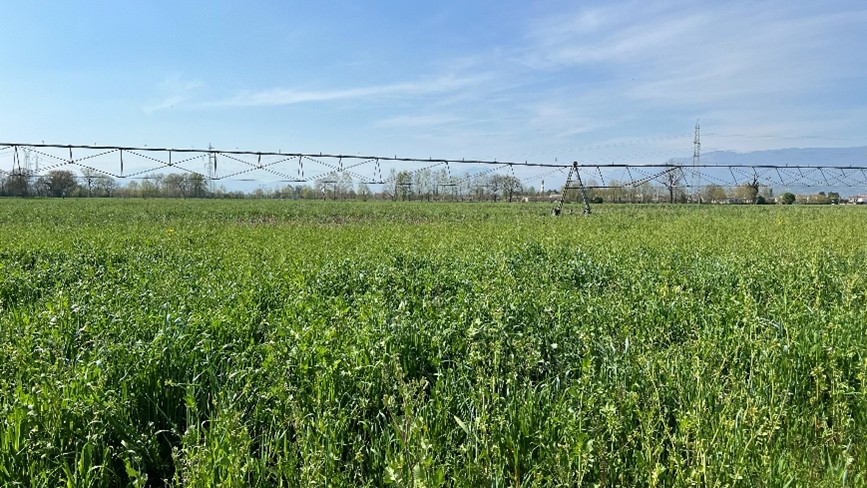
This is a no-till arable site with residue retention and pivot irrigation. Soil-health actions focus on expanding cover crop use, improving crop rotation design and maintaining reduced soil disturbance. The main crops are maize (food/feed), soybean (food/feed) and rapeseed (food/oilseed/industrial use).

This site represents a no-till arable system with residue retention and an already active use of cover crops. Soil-health management is centred on maximizing cover crop cycles, improving crop sequence design and maintaining no-till. The crops include peas (food/feed), wheat (food/feed), maize (mainly feed) and soybean (food/feed).

This is a no-till site with residue retention and sprinkler irrigation. Soil-health practices include maintaining reduced tillage, improving nutrient timing, introducing or strengthening cover crops, and diversifying crop rotations. The crops considered are maize (mainly food), wheat (food/feed), soybean (food/feed) and buckwheat (food niche crop).

This farm is particularly relevant within SHARE because it represents a rice-based coastal plain system. Soil-health practices include residue incorporation, rotation diversification beyond rice, introduction of cover crops/intercrops, improved nutrient timing, and the reduction of deep tillage in favour of more minimum tillage. The crops are rice (food), soybean (food/feed), maize (mainly food) and wheat (food/feed).

This is a diversified low-input arable site with no-tillage or minimum tillage, residue retention, organic fertilisation and legume-based self-fertilisation strategies. Soil-health management is strongly linked to biological fertility, continuous soil cover and rotation diversity. The crops include rice (food), wheat (food), millet (food/feed niche), oats (feed/food), beans (food/feed) and cover crops.

This is a diversified arable site under minimum tillage for all crops, with residues retained, mixed organic/synthetic fertilisation, and sprinkler plus drip irrigation. Soil-health actions include manure incorporation, improved nutrient timing, stronger cover-crop use, improved rotation design and reduced disturbance. The crops are soybean (food/feed), maize (mainly feed), wheat (food/feed), processing tomato (food) and alfalfa (feed).

This is a large mixed arable-beef farm where soil-health work combines organic and synthetic fertilisation, residue retention, cover crops, crop rotation improvement and the coexistence of tilled and no-till management. The site is useful to observe transitions in a large-scale commercial setting. The crops include soybean (food/feed), maize (mainly feed) and barley (food/feed), all in a livestock-linked context.

This arable site focuses on soil health through the introduction of organic amendments, cover cropping, improved crop sequences and reduced soil disturbance, together with residue incorporation. It is especially relevant because it includes a processing tomato system, which is strategic in northern Italy. The crops are wheat (food), processing tomato (food industry), maize (mainly feed) and cover crops.

This is a beef-cattle linked arable site under minimum tillage, with slurry and solid manure use, residue retention and pivot irrigation. Soil-health measures include manure incorporation, improved nutrient timing, possible use of nitrogen-cycle inhibitors, cover crops, better rotations and reduced disturbance. The crops are soybean (food/feed), maize (mainly feed), wheat (food/feed) and barley (feed/food).

This arable site combines slurry/solid manure inputs, residue incorporation and reduced disturbance, with planned strengthening through cover crops and manure incorporation strategies. It is useful as a representative intensive plain system under transition. The crops listed for the farm are soybean (food/feed), maize (mainly feed) and wheat (food/feed).

This is one of the most diversified sites and also includes a landscape element through existing tree/hedgerow cover. Soil-health practices include monitoring and strengthening tree cover, winter cover crops, diversified rotations, residue retention and reduced disturbance. The crops are sunflower (food/oilseed), rye (food/feed), grain landraces (food), millet (food/feed niche) and buckwheat (food).

This site combines minimum tillage, organic fertilisation and residue retention with soil-health actions aimed at improving tree/hedgerow components, cover cropping, rotation design and reduced disturbance. The cropping system includes soybean (food/feed), oats (feed/food) and alfalfa (feed).

This is an arable site with conventional tillage, residue retention and mixed organic/chemical fertilisation. Soil-health efforts are directed toward manure incorporation, cover crops, improved crop sequences and reduced soil disturbance. The crops are wheat (food/feed), alfalfa (feed), maize (mainly feed) and soybean (food/feed).
Funded by the European Union (Grant no. 101157414).Views and opinions expressed are however those of the author(s) only and do not necessarily reflect those of the European Union, European Research Executive Agency (REA). Neither the European Union nor any other granting authority can be held responsible for them.
By subscribing, you confirm that you have read and agree to our Privacy Policy.